when a man attributes a deed to a role, office, corporate body, or other mask, he presents the mask as though it did the deed, however, liability never leaves the man, because the mask is fiction
a man needs to pretend a fiction is real;
there is always a man at each end of the chain;
feign a person to mask the man
the feigning of person
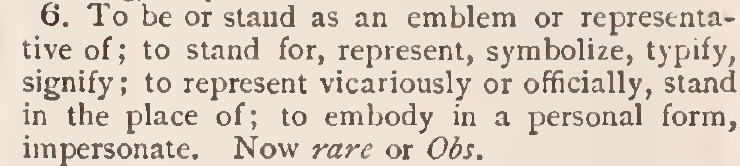
a 1609 OED quotation calls prosopopoeia “the feigning of a person”;
“our selues doe take their person vpon vs, or giue voice vnto senselesse things”;
1609 quotation under prosopopoeia; source image in the evidence below;
personation: a character assumed by a man; prosopopoeia: an imaginary or absent person, or a thing, presented as doing a deed; personification: the later gloss;
statements and attribution
| falsehoods | feigning of person |
|---|---|
| “I am a constable.” | personating; constable is a role, a mask, a fiction; |
| “The Police force detained you.” | prosopopoeia; 'Police force' is presented as though it did the deed; Police force is fiction |
| “The Chief Constable authorised me.” | prosopopoeia; Chief Constable is defined as a corporation sole, a fiction; a fiction can not authorise; |
| “My warrant card gives me authority.” | prosopopoeia; the card is presented as though it gives authority; |
| “HMCTS requires attendance / HMRC says £1,000 is owed.” | prosopopoeia; the masks HMCTS and HMRC are presented as though they require or speak; |
| “The Court ordered / decided.” | prosopopoeia; the mask, Court, is presented as though it ordered or decided; |
| “A man is prosecuted by the Police force.” | prosopopoeia; 'Police force' is presented as though it prosecuted; the mask: 'Police force' hides the deeds of man kind; |
falsehood, deceit and fraud
the use of prosopopoeia or personating to mask a role, legal person, company, corporation, corporation sole, or office as a separately existing person is falsehood;
- falsehood;
- the feigned person, a fiction, is presented as fact, and a deed is falsely attributed to the fiction, not the man;
- deceit;
- the man knowingly uses that false appearance to mislead another man;
- fraud;
- the man uses that deceit for unjust gain or advantage, such as payment, compliance, attendance, surrender, process, control;
where man kind use artificial persons as masks for their deeds in society or government to obtain compliance or control, the falsehood is the means, deceit is its knowing use, and fraud is the deed;
conclusion
by personation, a man pretends he is the mask; by prosopopoeia, he gives voice to the feigned person or attributes a deed to it; the feigned person is his mask; the man does the deed; liability never leaves the man;
evidence
source images and records;
OED word evidence
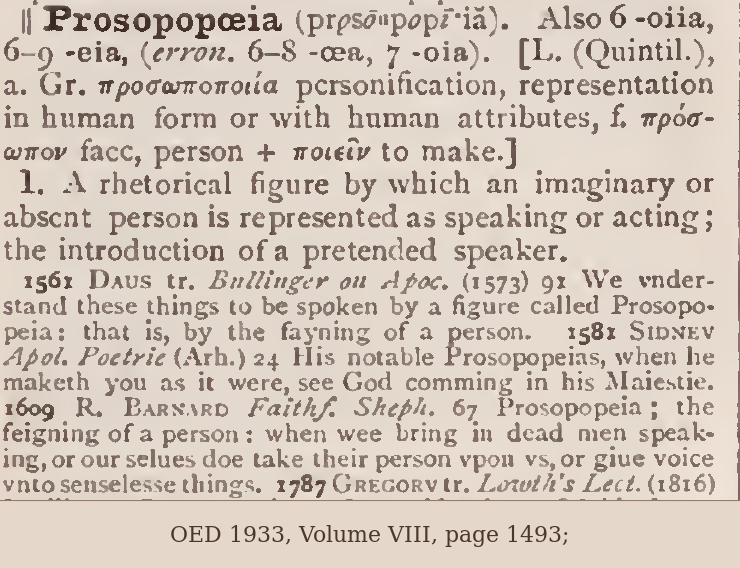
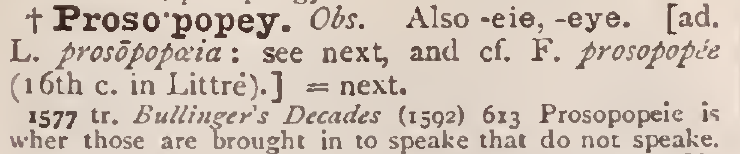
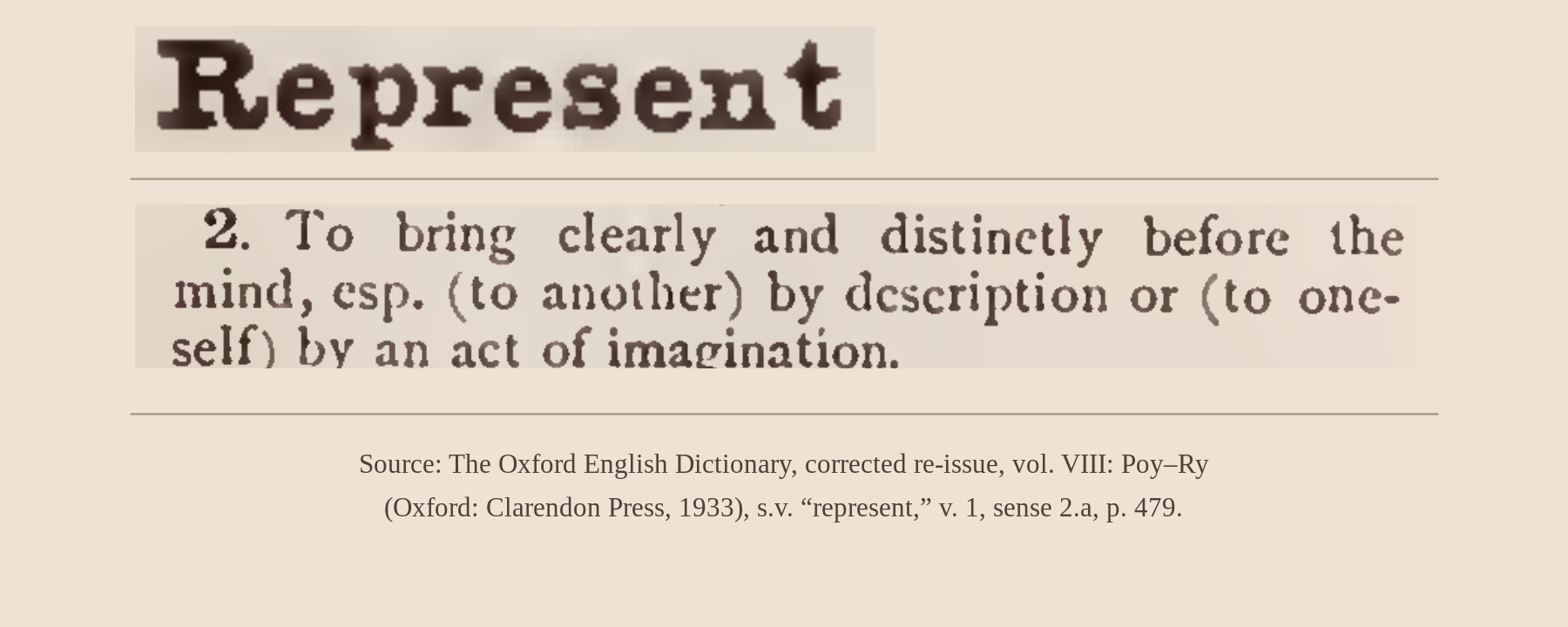
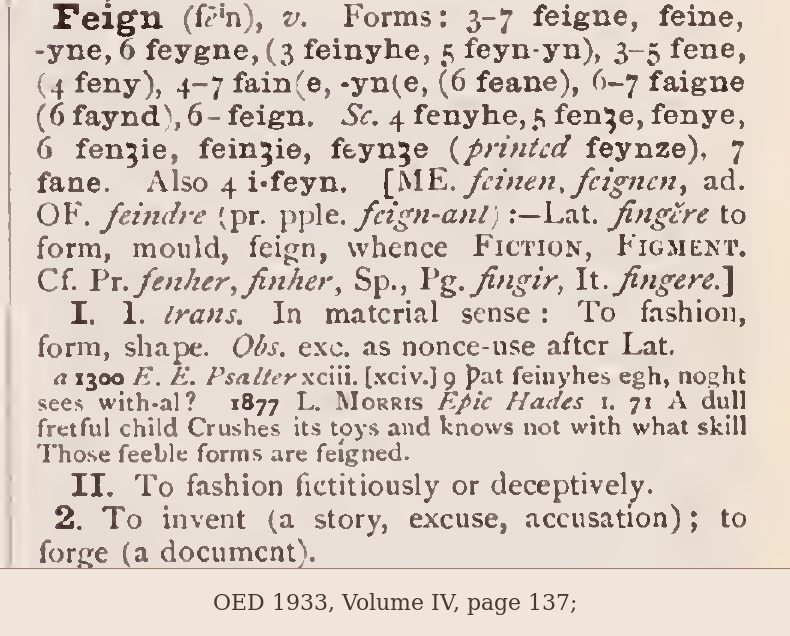
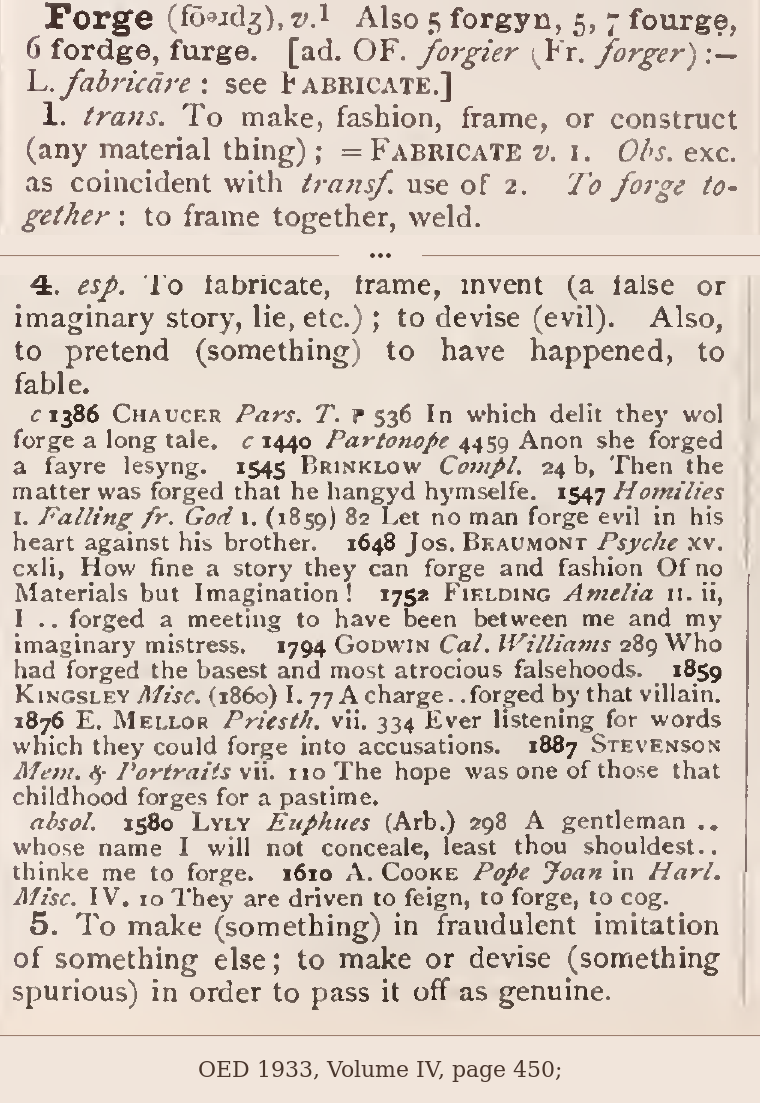
the images contain the headwords, selected senses, dates, and spelling; the definitions below are short working summaries, not replacements for the complete entries;

word families and working sequence
these form overlapping word families rather than one strict etymological chain;
| word | short meaning |
|---|---|
| personate | to play or assume a character; to pass oneself off as another person; in OED sense 6, now rare or obsolete, to represent vicariously or officially; in rare sense 7, to represent a thing as a person; state the sense used; |
| personating | the action expressed by personate; on this page, the deed of the man who personates; |
| personation | the action of personating; recorded senses include assuming or passing oneself off as another person, dramatic representation, and embodiment; the word alone does not prove deceit; |
| personify | to represent a thing or abstraction as a person, or attribute personal characteristics to it; |
| personification | the attribution of personal form, nature, or characteristics, or representation of a thing or abstraction as a person; the later English gloss for the second sense of prosopopoeia, not a separate stage; |
| prosopopey | obsolete English form of prosopopoeia; |
| prosopopoeia | a rhetorical figure by which an imaginary or absent person is represented as speaking or acting; also one by which an inanimate or abstract thing is represented as a person or with personal characteristics; |
| feign | from Middle English through Old French feindre and Latin fingere, “form, mould, feign”; senses include fashion or form, invent, represent in fiction, imagine, disguise, and pretend; no compulsory sequence runs through the senses; |
| feigning | the action of feign; in a rare sub-sense the OED records “feigning of person: personification”; |
| fayning / feyning | historical spellings of feigning; the cited 1561 quotation has fayning and the 1609 quotation has feigning; |
| feigned person | working description for the name, role, office, or thing presented as though it spoke or did the deed; no person or being is produced; |
| fiction | in OED sense 3b, something imaginatively invented: a feigned existence, event, or state; invention opposed to fact; sense 3a allows invention for deception or otherwise; |
| figment | something moulded or fashioned, an invented statement or story, or a notion framed in the mind, according to the selected sense; |
| forge / forging | in the relevant senses, to fabricate a false or imaginary account, or make something spurious to pass as genuine; a separate word family from feign, fiction, and figment; |
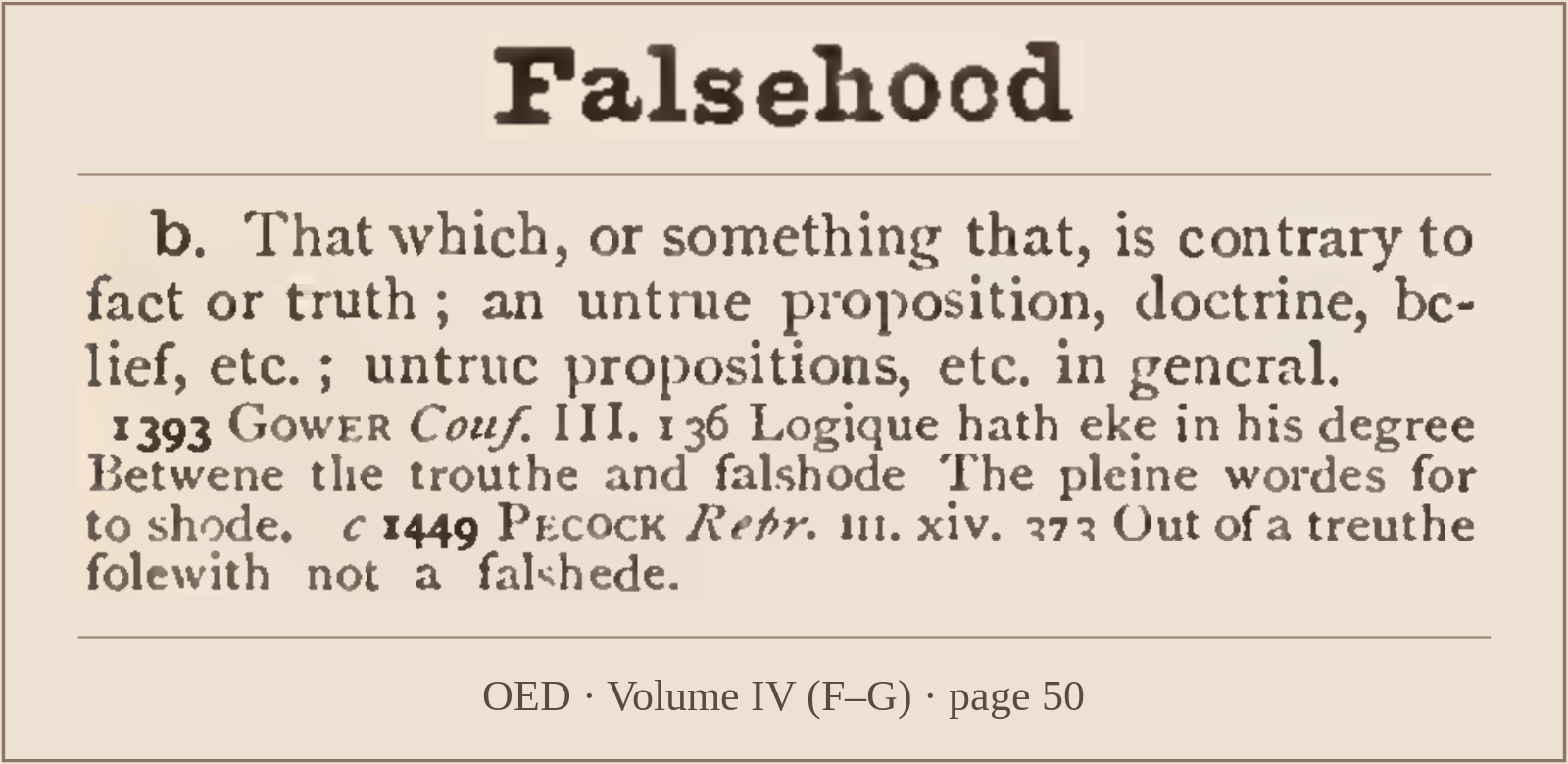
| falsehood | what is presented does not accord with fact or what is true; |
| deceit | working use: a man knowingly uses falsehood, false appearance, or a concealed fact to mislead another man; |
the useful working sequence; select each word only where the words and deed establish it;
- personation; where a man personates, his deed is personation;
- prosopopoeia; where a man presents an imaginary or absent person as speaking or acting, or an inanimate or abstract thing as a person, the representation is prosopopoeia;
- feigned person; the apparent person presented by the words is described here as the feigned person;
- falsehood; where what is presented does not accord with fact or what is true, it is falsehood;
- deceit; where a man knowingly uses the falsehood, false appearance, or concealed fact to mislead another man, his deed is deceit;
“forging a false person” is the stronger applied description where a man fabricates a false person-representation, or makes a spurious representation to pass as genuine; it is not an OED expression or a necessary stage; the older source expression for the basic device is “feigning of person”;
the false separate doer is falsehood; knowing use of that false appearance to mislead is deceit; use of the deceit for gain, advantage, payment, compliance, attendance, surrender, process, control, or loss is fraud;
official source evidence
these sources record the institutional words and arrangements used in the examples; they do not replace the factual question: which man spoke, wrote, decided, demanded, touched, stopped, bound, or took?
Police force and constable
Police Act 1996, section 2 records that a Police force shall be maintained for every police area listed in Schedule 1;
section 29 contains attestation as a constable by making the declaration in Schedule 4; its words include causing the peace to be kept and preserved, and preventing offences against people and property;
Chief Constable and clothing
Police Reform and Social Responsibility Act 2011, section 2 records that each Police force is to have a Chief Constable, with words about direction, control, and functions;
Schedule 2, paragraphs 2 and 3 describes a Chief Constable as a corporation sole and prescribes the office-name; Police Regulations 2003, regulation 45 contains words about the issue of uniform and equipment;
British citizen
on 30 October 1981, man kind in Parliament enacted provisions for the statutory status called British citizen in the British Nationality Act 1981; those provisions came into operation on 1 January 1983 under article 2 of the Commencement Order; the earlier status called citizen of the United Kingdom and Colonies came into operation on 1 January 1949 under section 1 and section 34(2) of the British Nationality Act 1948; the ordinary expression “British citizen” is older and appears in Hansard on 1 February 1900;
HMCTS
on the official HMCTS page, man kind have written of Court and tribunal administration, work with an independent judiciary, and staff employed by HMCTS;
prosopopoeia; HMCTS is presented as though it required attendance;
HMRC and Court
on the official HMRC page, man kind describe the department, the Commissioners for Revenue and Customs Act 2005, and commissioners appointed by the King;
prosopopoeia; HMRC is presented as though it spoke; Court is presented as though it ordered or decided;
man kind may use statutory wording to attribute a function, decision, power, or deed to a name; this page returns the observable deed to the man without pretending that every named structure has the same recorded form;
the origin of the imaginary person
in the Oxford English Dictionary (1933), under fiction, n., sense 5 and sub-sense a, “in Law”, a legal fiction is recorded as “a supposition known to be at variance with fact” but conventionally accepted for practical convenience, traditional usage, decorum, or a similar reason;
Oxford English Dictionary, corrected re-issue, Volume IV, F–G (1933), printed page 187, fiction, n., sense 5 and sub-sense a, “in Law”;
where the supposition and its boundary are openly stated, that differs from a concealed falsehood; it also differs from the later language of an artificial person, through which man kind attribute property, rights, duties, proceedings, or succession to one continuing name;
in Book IV, title VI, paragraphs 3–5 of the Institutes issued under Justinian in A.D. 533, it is written that a real action could proceed upon the fictitious allegation that title by usucapion had been completed when it had not; upon that recorded supposition, a man could seek a remedy although the required period had not run; this was fiction used as procedure, not the production of another being;
Justinian, Institutes, Book IV, title VI, paragraphs 3–5;
Roman rules for collective bodies developed separately; in the Roman sources, persona could describe a role or an individual, while a collective body was ordinarily described as universitas, corpus, or collegium; common property, representation, debts, and continuity could be attributed to that body despite changes among its members; from the twelfth century, lawyers and canonists worked these materials into more explicit accounts of collective continuity; in the thirteenth century, Innocent IV and later canonists used the language of persona ficta for corporate bodies; the modern technical legal person is therefore not merely the Roman theatre-mask carried forward unchanged;
Digest 3.4, concerning actions by and against a corporate body; Visa A. J. Kurki, A Theory of Legal Personhood, chapter 2;
in England, rules concerning endowed property held by an ecclesiastical office-holder and his successors existed before the settled name corporation sole; the formative difficulty concerned the parish parson or single chantry priest: lawyers disputed what estate the serving parson held, how land given to him and his successors passed to later incumbents, what he could alienate or charge, and where the fee rested during a vacancy; Blackstone later explained the mature doctrine by reference to descent, personal debts, and the inconvenience of fresh conveyances; surviving reports show disputed development rather than one proved moment of invention;
the earliest corporate language located by Frederic William Maitland is a 1448 plea concerning a chantry chaplain; a reported statement in 1482 treated an endowed priest and his successors as a corporation, but the possibility remained disputed in 1522; Sir Robert Broke later called the parson a corporation and a corporation in succession, although Maitland could not establish that Broke used the exact expression corporation sole; Coke’s 1614 report of the 1612 Case of Sutton’s Hospital, placed the King with the parson as a one-person body politic;
the Tudor distinction between the King’s natural and politic capacities developed through particular property and incapacity disputes; it overlapped with, but was not created by, the corporation-sole classification; later jurists described the Crown as a corporation sole in particular contexts and man kind later applied the classification to further single offices; in 1765 William Blackstone wrote that artificial persons were “created and devised by human laws for the purposes of society and government”, divided corporations into aggregate and sole, and supplied the mature explanation of perpetual succession;
Frederic William Maitland, “The Corporation Sole” (1900), and “The Crown as Corporation” (1901); Marie-France Fortin, “The king’s two bodies and the Crown a corporation sole” (2021); William Blackstone, Commentaries on the Laws of England, Book I, chapter I, page 119, and chapter XVIII, pages 455–458;
“The honour of originally inventing these political constitutions entirely belongs to the Romans. They were introduced, as Plutarch says, by Numa;”
William Blackstone, Commentaries on the Laws of England, Book I, chapter XVIII, first-edition pages 456–457;
Numa is a name, not a device: Blackstone meant Numa Pompilius, whom Plutarch presented in a traditional account as the Sabine king chosen after Romulus;
in chapter 17 of the Life of Numa, Plutarch attributed to Numa the distribution of the people into groups according to their trades or arts; he listed musicians, goldsmiths, carpenters, dyers, leather-workers, curriers, braziers, and potters; he wrote that Numa grouped the remaining trades and “made one body out of all who belonged to them”; Plutarch presented the deed as a way to replace the larger Sabine-and-Roman division with smaller trade divisions;
Plutarch, Life of Numa, chapter 17.1–3, translated by Bernadotte Perrin (1914);
source boundary; Blackstone attributed the origin through Plutarch, and Plutarch attributed the grouping deed to Numa; Plutarch did not call those trade groups artificial persons: William Blackstone made that connection while writing the history of corporations; reading those words provides the traditional account given by those writers, not proof that Numa originated every later corporation, artificial person, or legal fiction;
in 1896 William Markby called the corporation sole a misnomer; in 1900 and 1901 Frederic William Maitland traced its church-property history and found no second person apart from the mortal office-holder; their disagreement with other jurists shows that fiction theory was one explanation of legal personality, not its entire history;
“After all, Coke’s corporation sole is a man: a man who fills an office … but a mortal man.”
Frederic William Maitland, “The Corporation Sole” (1900), in The Collected Papers of Frederic William Maitland, volume III, page 238;
William Markby, Elements of Law, fifth edition (1896), sections 136–145, printed pages 84–90; Frederic William Maitland, “The Corporation Sole” (1900) and “The Crown as Corporation” (1901), in The Collected Papers of Frederic William Maitland, volume III, pages 210–270;
during the nineteenth century, man kind in Parliament widened access to incorporation and limited liability; in the judgments delivered in Salomon in 1896 and reported in 1897, it is written that a duly incorporated company is distinct from its subscribers; in section 16(2) of the Companies Act 2006 it is written that the subscribers and later members “are a body corporate” under the registered name; through these written rules, man kind attribute property, debts, capacity, proceedings, and succession to that name;
Salomon v A Salomon & Co Ltd [1896] UKHL 1, [1897] AC 22; Companies Act 2006, section 16;
legal person
as a present-day example, in HMRC’s VAT Registration Manual it is written that a legal person is “an entity or body which has an existence separate and distinct from the persons … comprising that entity or body”; corporate bodies, corporations sole, Scottish partnerships, and European Economic Interest Groupings are given as examples;
HMRC, VAT Registration Manual, VATREG02100, “Basic principles of registration: meaning of person”;
body corporate and body politic
the distinction; body corporate and body politic are not two opposite kinds; their written meaning depends upon the source and context, and historical sources sometimes use the expressions for the same corporation;
- body corporate; in the current UK legislative-drafting guidance, man kind distinguish a body with members from a corporation sole; examples expressly described as bodies corporate include a registered company, a limited liability partnership, a county or district council, an NHS trust, and a charitable incorporated organisation;
- corporation sole; in that guidance, man kind describe an office held by a single individual; for the Companies Acts, in section 1173 it is written that “body corporate” and “corporation” do not include a corporation sole; in section 7 it is written that one or more persons may form a company, and in section 16 the subscriber or subscribers and later members are described as the body corporate; that is distinct from a continuing incorporated office;
- body politic; William Blackstone, a man, used the expression historically for an artificial person or corporation; it has also been used for a political community, state, or attributed public capacity; it is therefore neither a universal modern synonym for body corporate nor its opposite;
- body politic and corporate; both expressions have been written together for one body; examples include the historical General Board of Health, rectors of new Manchester parishes, the Council of the Durham Colleges, and the Institution of Chemical Engineers in a 2024 Privy Council charter instrument;
application; body politic is a written classification; it does not produce another natural body or another man; a man does the deed, while man kind may use a written rule to attribute legal consequences to a body-name or continuing office-name;
source boundary; the legislative-drafting guidance records current drafting practice rather than one universal definition; section 1173 is expressly limited to the Companies Acts; Blackstone, older enactments, and charter instruments record their own historical or particular uses;
the development and types of legal fiction
there is no single recorded date upon which legal fiction was introduced; different devices developed along separate lines and were later grouped under overlapping names; this chronology concerns legal devices rather than story, drama, or ordinary imaginative fiction;
strict legal fiction ordinarily assumes a fact known to differ from fact for a limited legal purpose; artificial personality and continuing-office capacity form an adjoining history, but not every source describes those constructs as strict factual fictions;
| period | recorded development | type |
|---|---|---|
| early Roman practice; recorded about A.D. 160 | Gaius recorded mancipatio as an imaginary sale; formal words and acts were used to produce an attributed legal result although no ordinary sale occurred; | symbolic or staged transaction; |
| 87 B.C. | in the Tabula Contrebiensis, it is written that judges were to decide a civic dispute as if a stated civic condition were true; this is a securely dated surviving example, not a proved first invention; | fact; civic status; jurisdiction; |
| about A.D. 160 | Gaius recorded praetorian formulas which assumed completed usucapion, heirship, or Roman citizenship, or disregarded a change of civil status, so that a claim could proceed; | procedural; remedial; status; capacity; |
| A.D. 533 | in the compilation issued under Justinian, earlier Roman procedural fictions were preserved; in Digest 3.4, the Latin heading and passages use universitas for a collective whole (see Oxford English Dictionary, university, n.), with common property, a common chest, representation, separate debts, and continuity despite changing members; A.D. 533 is a date of compilation and transmission, not the origin of the devices; | procedural fiction; universitas or collective-body antecedent; |
| twelfth to mid-thirteenth centuries | lawyers and canonists systematised the Roman materials concerning collective bodies; Innocent IV is commonly associated with the account of a collegium as one feigned person, later expressed through persona ficta; | corporate or artificial person: aggregate; |
| thirteenth to fourteenth centuries, England | men used quo minus, alleging an inability to pay a debt to the King, as the means by which another debt claim could be heard in the Exchequer; | jurisdictional fiction; |
| 1440s to 1502 | lawyers developed common recoveries through collusive proceedings used to bar restrictions upon inherited land; the process was not created for the first time by Taltarum's Case in 1472; | property; conveyancing; procedure; |
| 1430 to 1612 | ecclesiastical property and succession rules preceded the settled label; surviving reports move through disputed corporate language for one chantry priest or parson, Broke’s mid-sixteenth-century treatment of the parson as a corporation, Tudor distinctions between the King’s natural and politic capacities, and Coke’s later classification of the King as a one-person body politic; the detailed source trail follows below; | artificial succession; office capacity; political or public capacity; |
| about 1500 to the mid-seventeenth century | men used the Bill of Middlesex, ejectment, fictitious leases, entries and ousters, and nominal parties such as John Doe and Richard Roe in court procedure; | jurisdiction; custody; nominal party; property procedure; |
| 1765 | William Blackstone organised the mature English doctrine into natural and artificial persons, corporations aggregate and sole, and perpetual succession; this was a classification of existing doctrine, not its invention; | doctrinal classification; |
| 1833 to 1852 | man kind in Parliament replaced many older procedural forms, including common recoveries, fictitious ejectment parties, and some jurisdictional devices; those changes did not end legal fiction generally; | removal of older procedural fictions; |
| 1844 to 1897 | in 1844 man kind in Parliament made incorporation by registration more widely available; in 1855 limited liability was made available to qualifying registered companies; in the judgments in Salomon in 1896, reported in 1897, it is written that a duly incorporated company is distinct from its subscribers; | commercial corporation; separate legal personality; |
| modern legislation | man kind use “deemed”, “treated as”, and “as if” rules for limited purposes including tax, adoption, service, restoration, status, and corporate continuity; | express statutory fiction; status; continuity; |
British citizen;
source; under the heading Acquisition by birth or adoption, in section 1(1) of the British Nationality Act 1981, as enacted, it is written: “A person born in the United Kingdom after commencement shall be a British citizen”;

application; United Kingdom is a body politic, not a place; it does not exist; only fiction can be born in the United Kingdom; see /uk; arising as it does in a Crown Act of Parliament, a British Citizen is a Crown licensed product, and as such, can not exist in reality;
the first use and development of corporation sole;
there is no securely documented single first use; the underlying succession arrangement, the earliest surviving corporate description of one office-holder, and the first settled use of the exact expression corporation sole are different questions;
Maitland did not identify the first surviving use of the exact expression; the chronology below therefore records precursor rules, early corporate descriptions, and the later settled classification rather than a proved first coinage;
| period | recorded source | what it establishes |
|---|---|---|
| 1430 | in a dispute concerning land recovered from an earlier parson, judges disagreed whether the serving parson had an estate for life, a fee simple, or property in right of his church; they also disagreed about where the interest rested while the benefice was vacant; | the property and succession problem existed before the corporate label; |
| 1448 | a writ was brought in the name of “John Chaplain of the Chantry of B. Mary of Dale”; when the missing surname was challenged, counsel answered that he might be understood as corporate under that office-name; | the earliest surviving one-office corporate language located by Maitland; not the first proved use of the exact expression corporation sole; |
| 1482 | Bryan CJ and Choke J were reported as treating a licensed endowment to one chantry priest and his successors as “a good corporation without further words”; | an early one-priest corporation statement; Maitland cautioned that it was a gratuitous dictum in a municipal-corporation case and that later opinions differed; |
| 1520 to 1522 | judges continued to dispute where the fee simple of the parson’s glebe rested; in 1522 Fineux CJ rejected the proposed corporation of one man because one man was not permanent and could not have successors; | the one-man construction remained contested and corporation sole was not yet settled terminology; |
| before 1558; published 1568 | Sir Robert Broke’s La Graunde Abridgement called the parson a corporation and a corporation in succession when explaining gifts to a parson and his successors; | Broke prepared the way for the later classification; Maitland could not establish that Broke used the precise expression corporation sole; |
| 1555 to 1573 | Tudor reports developed distinctions between the King’s natural and politic capacities in particular disputes about dignity, minority, grants, and land; the 1561 Case of the Duchy of Lancaster concerned a lease of Duchy land made by Edward VI during his minority; | a related capacity doctrine which preceded Coke’s reported sole-and-aggregate classification and did not itself supply one complete public-and-private property division; |
| 1591 | in Fulwood’s Case, the Chamberlain of the City of London was treated by custom as a corporation in succession for the special purpose of taking recognizances concerning orphanage money; | an early lay office given sole-corporate capacity for a limited customary purpose; |
| 1612; report published 1614 | in Coke’s report of Sutton’s Hospital, every corporation or body politic was said to stand either upon one sole person, “as the King, bishop, parson”, or to be aggregate of many; | a clear reported sole-and-aggregate classification involving the King; Coke wrote King here, not Crown; |
| 1840 to 1876 | man kind in Parliament gave sole-corporate status or capacity to further public offices, including the Postmaster-General in 1840, Treasurer of Public Charities in 1853, Secretary of State for War in 1855, and Treasury Solicitor in 1876; | “other single offices” describes a development extending across centuries, not one event confined to the fifteenth or sixteenth century; |
why the parson mattered; the serving parson possessed and benefited from the church property, glebe, and tithes, but lawyers disputed what estate he held, what he could alienate or charge to the prejudice of his successor, how the next parson took, and where the fee rested during a vacancy; Blackstone later explained the mature doctrine by saying that it kept the endowment from descending to the incumbent’s heir, answering his private debts, or requiring a fresh conveyance;
why the bishop was not the formative case; a medieval bishop was ordinarily understood as head of a continuing aggregate body consisting of bishop and chapter; the solitary parish parson had no chapter or other continuing group behind him; Elizabethan and Jacobean lawyers later applied the new sole-corporation terminology to bishops, deans, prebendaries, and other ecclesiastical offices;
how the King entered the classification; the Tudor reports concerning natural and politic capacities preceded Coke’s settled sole-and-aggregate taxonomy; Coke then placed the King beside the parson as a one-person body politic; later jurists described the Crown as a corporation sole, but corporation sole, the King’s two bodies, dignity, office, and Crown do not have one identical history;
what the mature explanation did; Blackstone wrote in 1765 that a parson and his successors were one person in law and that the King was made a corporation to prevent an interregnum and preserve Crown possessions; this explains the later orthodox doctrine, not its first use; Maitland answered that no second detachable person appeared and that, when the incumbent died, the freehold still fell into abeyance;
corporation-sole sources: Frederic William Maitland, “The Corporation Sole” and “The Crown as Corporation”; Marie-France Fortin, “The king’s two bodies and the Crown a corporation sole”; X v The Lord Advocate [2025] UKSC 44, paragraphs 39–42; Communications, Electrical, Electronic, Energy, Information, Postal, Plumbing and Allied Services Union of Australia v Queensland Rail [2015] HCA 11, paragraphs 17–18 and footnote 21; William Blackstone, Commentaries, Book I, chapter XVIII;
corporation-sole source boundary; the 1448 plea is the earliest precursor located in Maitland’s evidence, not a proved first use of the exact term; the 1482 words were not settled doctrine; the Tudor capacity cases and the corporation-sole classification overlap but remain distinct histories; bishops did not supply the difficult first English case; and rules of succession do not prove the presence of a second man or another being;
sources: Gaius, Book I; Tabula Contrebiensis, 87 B.C.; Gaius, Book IV; Justinian, Institutes, Book IV; Digest 3.4; Kurki, A Theory of Legal Personhood, chapter 2; Wurzel, “The Origin and Development of Quo Minus”; Biancalana, “The Origin and Development of the Common Recovery”; Maitland, “The Corporation Sole” and “The Crown as Corporation”; Blackstone, Book I, chapter XVIII; Ames Foundation, ejectment; Fines and Recoveries Act 1833; in section 168 of the Common Law Procedure Act 1852; The National Archives, registered companies; Limited Liability Act 1855; Salomon v A Salomon & Co Ltd; in section 67 of the Adoption and Children Act 2002; Civil Procedure Rules, Part 6; in section 1032 of the Companies Act 2006; Fowler v HMRC;
the main types;
- symbolic or staged transaction; prescribed words or acts are treated as producing a legal result different from their ordinary appearance;
- procedural or remedial fiction; a counterfactual allegation permits a claim or remedy to proceed;
- status or capacity fiction; a man or thing is treated as having, retaining, or lacking a stated status or capacity for a limited purpose;
- jurisdiction, venue, or custody fiction; an assumed fact supplies the route into a particular court or procedure;
- nominal-party fiction; an invented name or party occupies a place in proceedings;
- property or conveyancing fiction; a staged or collusive proceeding changes the treatment of land, title, or succession;
- collective or aggregate artificial personality; property, duties, proceedings, and continuity are attributed to one collective name;
- corporation sole or continuing-office capacity; official property and capacity are attributed through successive holders of one office-name;
- political or public capacity; private and attributed official capacities are distinguished;
- express statutory fiction; words such as “deemed”, “treated as”, or “as if” state the assumed position and its purpose;
source boundary; the dates and source statements record different devices; the type names above are a working synthesis rather than the words of every source; corporation sole was one later branch, not the beginning of legal fiction generally; rhetorical prosopopoeia is related through language but is not automatically a legal fiction; a fiction is not a man and does not perform a deed: the words are written and applied by man kind;